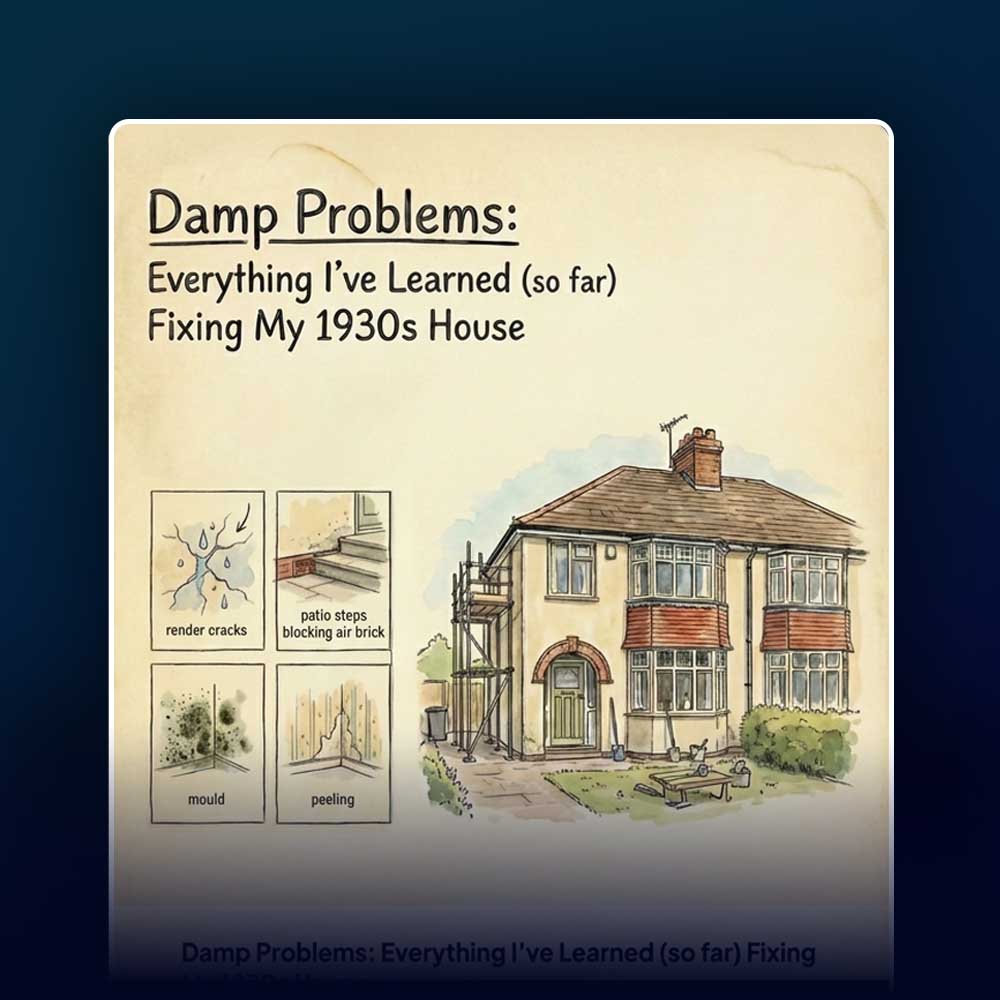
Damp is one of the most confusing — and overwhelming — problems you’ll face when renovating an older house.
When I bought my 1930s place, I assumed damp was a single issue with a single fix.
A leak. A treatment. A quick job.
It turned out to be nothing like that.
Over the last year I’ve been stripping things back, digging outside, unblocking air bricks, watching walls during heavy rain, and slowly learning how moisture actually behaves in old buildings.
I’m not a surveyor. I’m not a damp “expert”.
This is simply what I’ve learned so far while fixing damp in my own house.
If you’re dealing with damp right now, this page should help you:
- Understand what might be causing it
- Spot the obvious problems early
- Avoid wasting money on the wrong fixes
Hopefully this article helps but if you want the deeper explanations, diagrams, tests and step-by-step checks you can get that for free inside the Reno Club.
First: Damp Is Rarely Just One Thing
One of the biggest mindset shifts for me was realising this:
Damp is almost never one problem.
It’s usually several small issues working together.
Things like:
- Rainwater being directed towards the house
- Walls that can’t breathe
- Blocked ventilation
- Cold surfaces causing condensation
- Small cracks letting water in over time
Individually, none of these seem dramatic.
Together, they cause mould, peeling plaster, musty smells and wet walls.
Once you start thinking about damp as a system rather than a single fault, it becomes far easier to understand — and fix.
Common Damp Symptoms to Look Out For
Before worrying about causes, start with what you can see and smell.
Typical signs of damp in older houses include:
- Black mould in corners or behind furniture
- Peeling or blown plaster
- White powdery residue on walls (salts)
- Dark patches that appear after rain
- Condensation on windows or cold walls
- Musty “old house” smells
- Tide marks low down on walls
These don’t diagnose the cause — but they’re your first clues.
Where the Damp Appears Tells You a Lot

Something that helped me massively was paying attention to where the damp showed up, not just how bad it looked.
Very broadly:
Damp low down on walls (below ~1m)
Often linked to:
- High external ground levels
- Bridged damp proof course (DPC)
- Blocked or buried air bricks
- Persistent rain splashback
Damp in corners or behind furniture
Usually:
- Condensation
- Cold spots
- Poor airflow
Damp in bathrooms and kitchens
Often caused by:
- Steam
- Poor extraction
- Hidden pipe leaks
Damp high up or mid-wall
Commonly:
- Penetrating damp
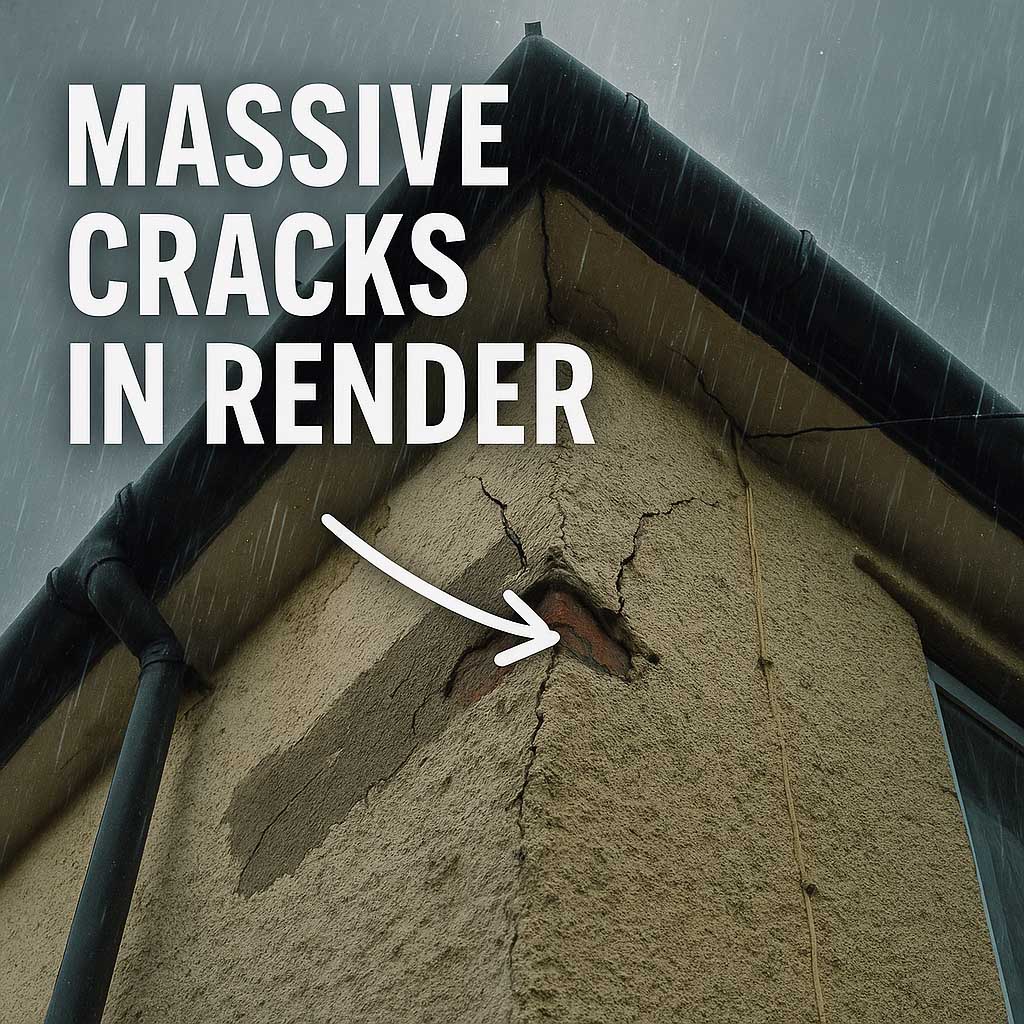
- Cracked render
- Failed pointing
- Leaking gutters or downpipes
Random isolated damp patches
Often:
- Slow hidden leaks inside walls or floors
In the full PDF, I break these locations down with diagrams so you can match them to your own house.
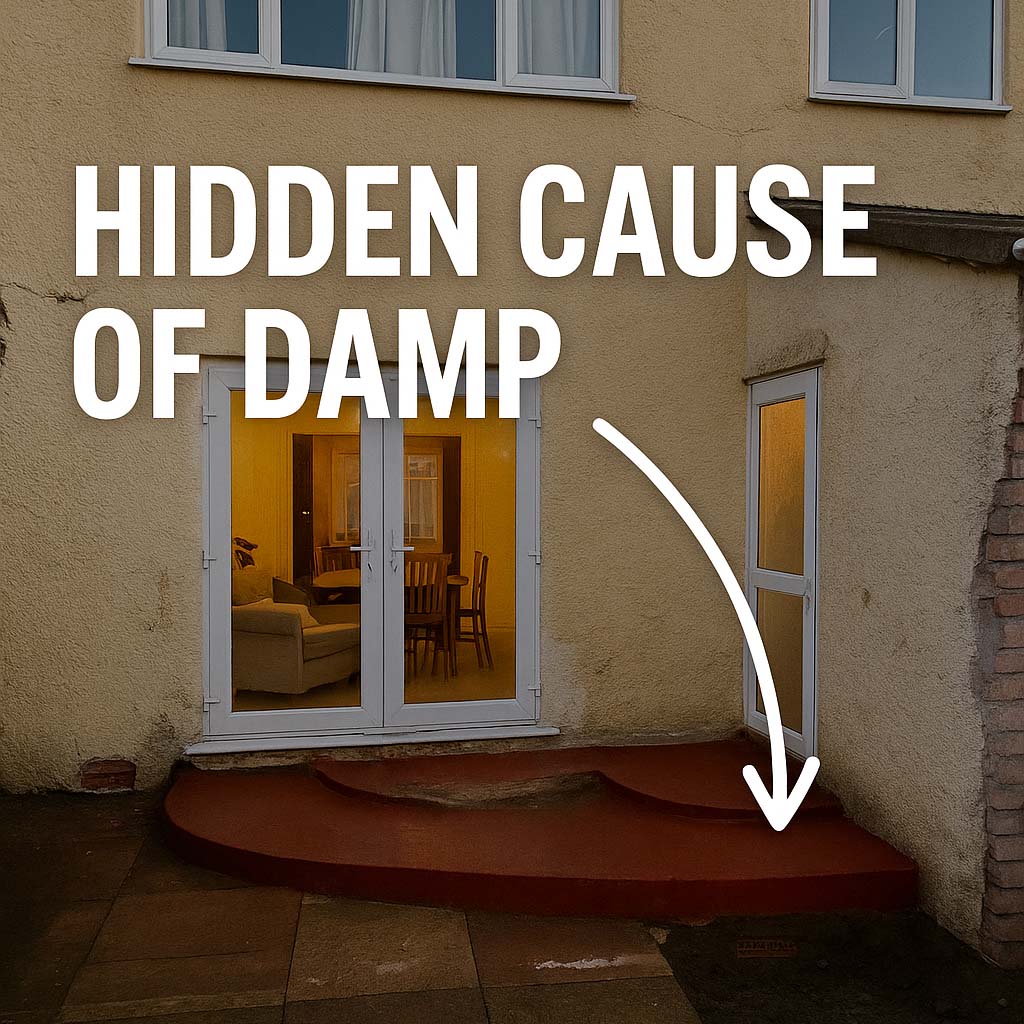
Don’t Ignore the Ground Outside Your House
This was the biggest thing I completely overlooked at the start.
I was so focused on the walls that I didn’t properly look at:
- Patio levels
- Concrete paths
- Decking
- Soil piled against brickwork
- Ground sloping towards the house
In older homes, moisture often enters from the outside at ground level.
Common problems include:
- Patios or decking built too high
- Concrete poured against brickwork
- Render taken all the way down to the ground
- Blocked or buried air bricks
- Ground that funnels rainwater straight into the wall
Lowering ground levels — even slightly — can make a huge difference.
Render Can Actually Cause Damp
If your house has old sand-and-cement render (especially pre-1950s solid walls), it’s worth paying attention.
Hard, non-breathable render can:
- Let water in through tiny cracks
- Trap moisture behind it
- Stop walls from drying out
- Eventually crack, bubble or blow off
That trapped moisture often shows up inside, nowhere near the actual crack.
Understanding why this happens is far more important than just ripping render off — which is why I go into this in detail in the guide.

Simple Damp Tests You Can Do Yourself
You don’t need specialist equipment to learn a lot.
Some genuinely useful tests:
- Touch test: cold + wet vs cold + dry + powdery
- Smell test: musty usually means long-term moisture
- Cling film test: helps identify condensation vs moisture coming through the wall
- Get some cheap hygrometers: tracking humidity room-by-room over time (af link)
I explain exactly how I used these (and what not to over-interpret) in the full PDF.
Quick Fixes That Often Make a Real Difference
Before spending serious money, these simple things solve more damp problems than you’d expect:
- Clear and unblock air bricks
- Fix leaking gutters and downpipes
- Improve ventilation and extraction
- Move furniture slightly away from cold walls
- Avoid drying clothes indoors (or use a dehumidifier)
- Improve insulation at cold spots
None of these are exciting — but they work.
When It’s Worth Calling a Professional
Some situations do need expert input:
- Large areas of mould
- Walls that stay wet all year
- Electrical sockets affected
- Structural cracks
- Suspected leaks you can’t trace
From what I’ve learned, an independent surveyor is often far more useful than anyone immediately pushing chemical damp treatments.
Why I Made the Damp Guide PDF
I made the Damp Guide because I wish I’d had something like it on day one.
It’s:
- Everything I’ve learned so far fixing damp in my own 1930s house
- Full of clear diagrams and explanations
- Written for normal people renovating real homes
- Not expert advice — just honest learning, clearly laid out
If this article helped even a bit, the full guide will save you time, stress and money.
Free Download: Get the Full Damp Guide
The complete Damp Problems PDF is available free to Reno Club members.
Inside the guide I go much deeper into:
- Diagnosing damp by location
- Ground level mistakes to avoid
- Render and breathability explained properly
- Simple tests that actually work
- My exact fixes and what improved humidity
- Why damp is almost never just one issue
👉 Join the Reno Club (Free) & Download the Damp Guide
It’s completely free to join.
No spam. No hard sell. Just useful renovation info.
If you’re fighting damp right now — you’re not alone.
And you’re not imagining it.
You can make sense of it.
Download the PDF 👆
Join the Reno Club
Support My Rookie Reno
For anyone who’s thought ‘keep going, mate’ while watching — this is just a simple way to help more videos happen.
-
Mortar Rake Depth Guard for Angle Grinder
£29.95 -
Buy Me A Beer
£5.00 -
Jar of Cement Render Chips
£19.99